
Vertical Transportation
Elevators, escalators and moving walks are among the most closed legacy systems in the city, and the beachhead ELSA connected first. Statutory self-inspections, periodic inspections and in-depth self-inspections, on top of emergency calls from passengers, are more than a small maintenance workforce can handle. Equipment failures are caught through inspection data and passenger risks through video AI: ELSA manages equipment condition and passenger safety together on a single platform.
- Elevators
- Escalators & moving walks
- Wheelchair lifts
- Video-AI safety management
- Elevator maintenance PaaS/SaaS
We are turning an operating model proven at large public sites into a subscription service that small and mid-sized maintenance companies can use without building infrastructure, and extending video-AI safety management to high-traffic public facilities such as subway stations.
The challenge on site
The government has introduced a policy that grants more flexible inspection cycles to sites using the latest remote-monitoring technology, so that maintenance can be more focused. Escalator accidents, meanwhile, more often stem from passenger behavior than from equipment failure, so component condition alone cannot prevent them. ELSA predicts failures from equipment data while reading passenger risks with video AI, addressing both causes of accidents together.
What ELSA does
- Direct controller integrationConnects new and legacy elevators alike, regardless of manufacturer or model.
- Real-time monitoring and remote diagnosticsAlerts the central control room and engineers’ mobile devices the moment a component fails, so issues can be resolved remotely.
- Failure prediction and parts recommendationsPredicts the failing component and the parts needed, so crews come prepared and return visits drop.
- Integrated parts and schedule managementManages parts and inspection schedules across the entire elevator fleet, beyond individual units.
- Video-AI risk detectionAnalyzes AI camera footage at the edge in real time to determine passenger density, direction of travel and abnormal movement, adds equipment sensor readings as a secondary signal, and responds in stages with warnings, voice announcements and emergency stops.
- Subscription service for maintenance companiesSmall and mid-sized maintenance companies use ELSA by subscription, without servers of their own.
Expected benefits
- Proactive maintenancePrevents failures in advance through component life-cycle management
- Safety managementDetects the six major risks in advance with video AI, preventing serious accidents for passengers and inspectors
- Operational efficiencyFewer call-outs and return visits, and optimized staffing
Applicable equipment
Explore Elevator Remote ManagementExplore Escalator AI Safety
Case studies
We manage Korea’s largest multi-vendor elevator fleet, 22,372 units across 80 types and 450 models, on a single platform. We have won contracts to build integrated management and remote-inspection platforms for LH’s 4,264 public rental housing complexes nationwide and 294 units at Incheon International Airport, and are extending our reach with video-AI escalator safety management at Gwangan Station on the Busan Metro.
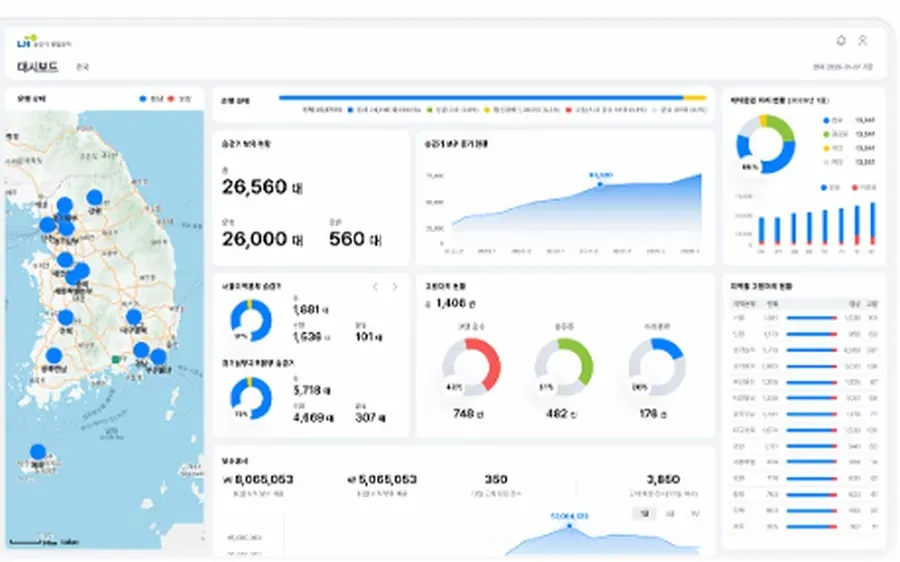 Korea Land & Housing Corporation (LH)4,264 public rental housing complexes nationwide
Korea’s first, and the world’s largest, AI-based public elevator management platform. It manages multi-vendor elevators in one place, with real-time monitoring, automatic fault reporting, remote inspection and integration with the National Elevator Information Center.
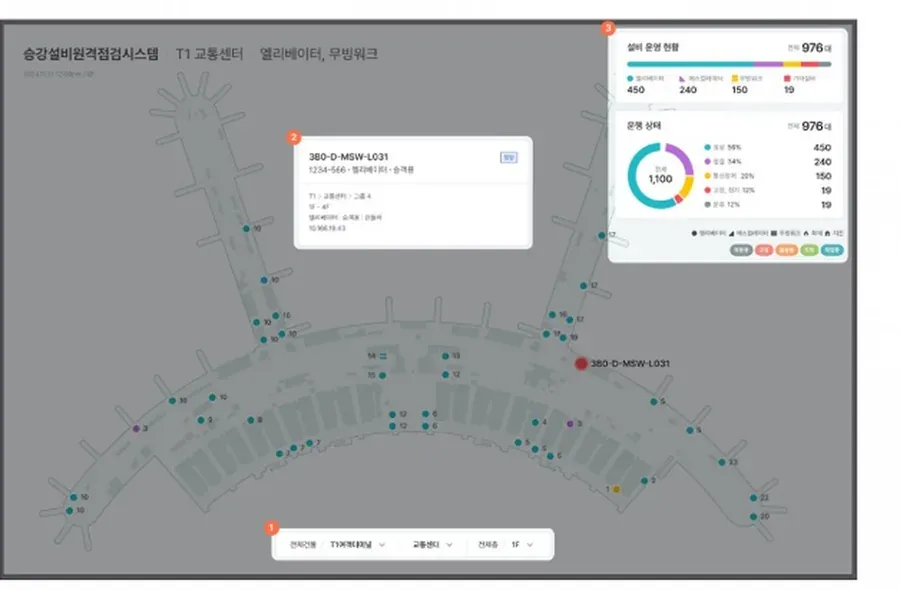 Incheon International Airport Corporation294 elevators
Connects the elevators and people-moving equipment of critical national infrastructure, where downtime is not an option, for real-time monitoring, proactive maintenance and remote inspection.
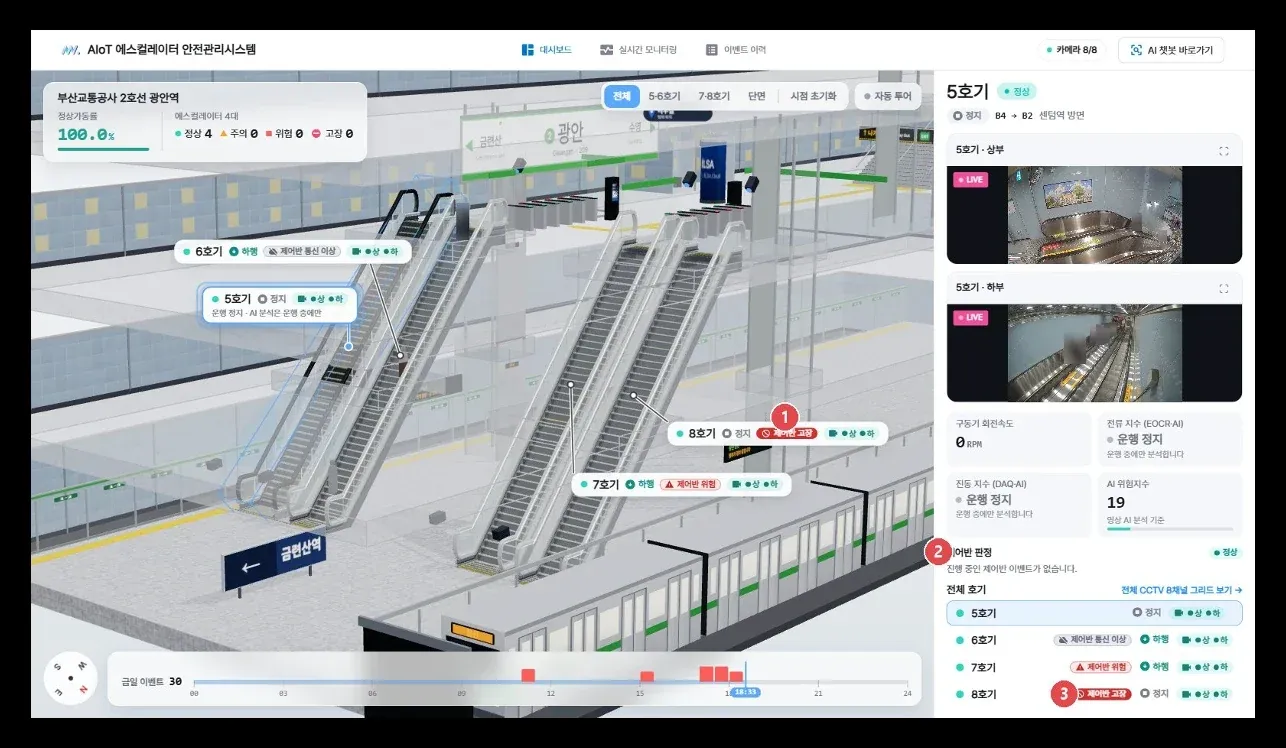 Busan Transportation CorporationEscalators at Gwangan Station, Busan
At Gwangan Station on the Busan Metro, we installed AI cameras, edge servers and control monitors for escalators No. 5 to 8, the concourse and the station safety office. The core is video-based AI analysis. Deep-learning models on the edge server interpret footage of the landings, steps and handrails in real time, reading passengers’ posture, density, direction of travel and abnormal movement. With equipment sensor readings added as secondary indicators, the system detects six risks in advance: crowding, wrong-way travel, sudden start or stop, passenger falls, abnormal events and wheelchair entry. Responses are staged by detection level (warning → voice announcement → inspection support → emergency stop), and the control screen provides real-time monitoring, risk analysis and diagnostic history.