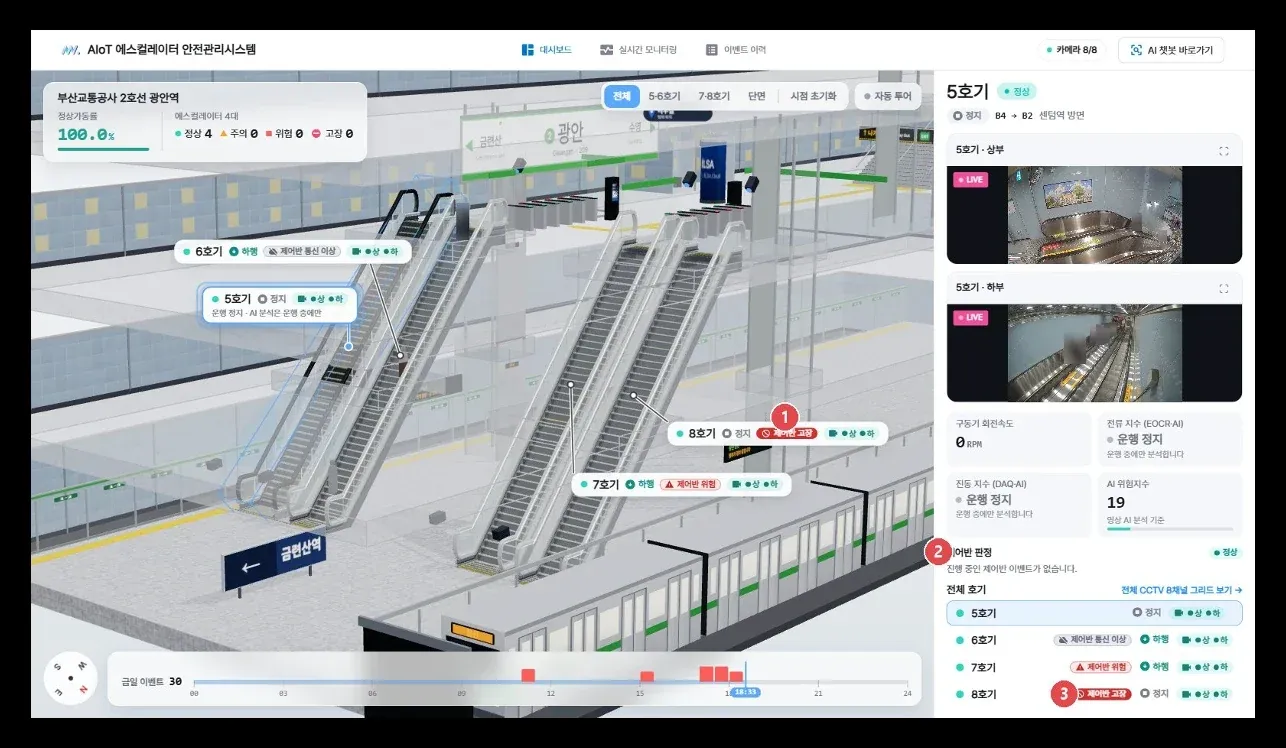
Escalator AI
AI video analytics detect and respond to risky passenger behavior and equipment anomalies in real time.
Escalator accidents are caused not only by the condition of the equipment but also by passenger behavior and on-site conditions. ELSA analyzes AI camera footage in real time on an edge server, detecting passenger posture, crowd density, direction of travel and abnormal movement.
It also analyzes equipment sensor data alongside the video, assessing passenger risk and equipment anomalies together and supporting a staged response according to the level of risk.
Components
A vision-based hazard recognition AI and a sensor-based anomaly detection AI work together.
Collects and analyzes sensor data from key escalator components to detect signs of abnormality and predict the likelihood of failure.
AIoT-based anomaly detection model
- Detects equipment anomalies from the sensor data of key components.
- Builds the AI model by fine-tuning a time-series foundation model on an escalator knowledge dataset.
- Predicts the likelihood of failure and the remaining service life of key components to support predictive maintenance.
Analyzes camera footage in real time to detect hazards arising from passenger movement and on-site conditions on the escalator.
Video-based accident and hazard recognition model
ELSA.Edge AI
- Monitors escalator operation in real time through cameras.
- Recognizes hazardous situations by analyzing video frame by frame.
- Analyzes passenger speed and movement.
- Detects risky behavior and abnormal movement by passengers.
- Recognizes hazardous objects and restricted riders in real time and issues warnings.